Creating habits
Okay, this could get a bit deep and meaningful… but here goes.
Recently I shared a post about the life lessons I’ve learned through running. What surprised me wasn’t just how many people resonated with it, but how clearly it forced me to articulate something I’d been feeling for a while: real progress doesn’t come from big heroic moments, it comes from doing the boring, important stuff consistently.
Running showed me that. But the idea actually started earlier than I realised.
I’ve always known about habits. Everyone does. Eat well, move your body, be disciplined, rinse and repeat. But knowing something and actually living it are two very different things. For me, the penny first dropped with something ridiculously simple: making my bed.
At the time, I was going through a pretty big life shake-up. One of those periods where everything feels a bit unstable and you’re just trying to find something solid to hold onto. Somewhere in that headspace, I picked up the book Make Your Bed. I won’t pretend it was life-changing in a dramatic way, but one idea stuck hard.
Making your bed is the first optional task of the day. No one is watching. There’s no reward. You’re just going to mess it up again later anyway. And yet… you either do it or you don’t.
I decided to do it.
Not because it made my room look better, but because it felt like a small declaration: I’ve already won once today. Over time, not making the bed started to feel like dropping my own standards. Now it’s just part of my day. A quiet signal to myself that I’m showing up.
What surprised me was how that mindset bled into other areas of my life - especially running.
When I first got serious about running, I set some pretty lofty goals. And honestly, I was frustrated. I was training, but not improving the way I thought I should be. That’s when I committed to a 100-day challenge, holding myself accountable by uploading a video after each run.
It worked. Not magically - mechanically.
I ran more often. I skipped fewer days. I stopped negotiating with myself. The results came because the habit came first. Looking back, it’s obvious. At the time, it felt like momentum.
Fast forward to the start of 2026 and I was sitting down doing some annual planning. Less “new year, new me” and more a genuine question: If I was a better person by the end of this year, what would that actually look like?
I ended up with five Post-it notes stuck above my desk - my guiding lights. Underneath them, I wrote the actions I believed would move the needle. And under those I deliberately went even smaller. Tiny habits. Almost boring ones. The kind that don’t feel impressive, but quietly stack.
For example:
Daily journaling - not because I love writing, but because reflection helps me recognise wins and catch patterns early.
Ten minutes of stretching - good for my running, but even better for a desk-bound body that likes to tighten up when I’m not paying attention.
That’s when the habit tracker idea came to life.
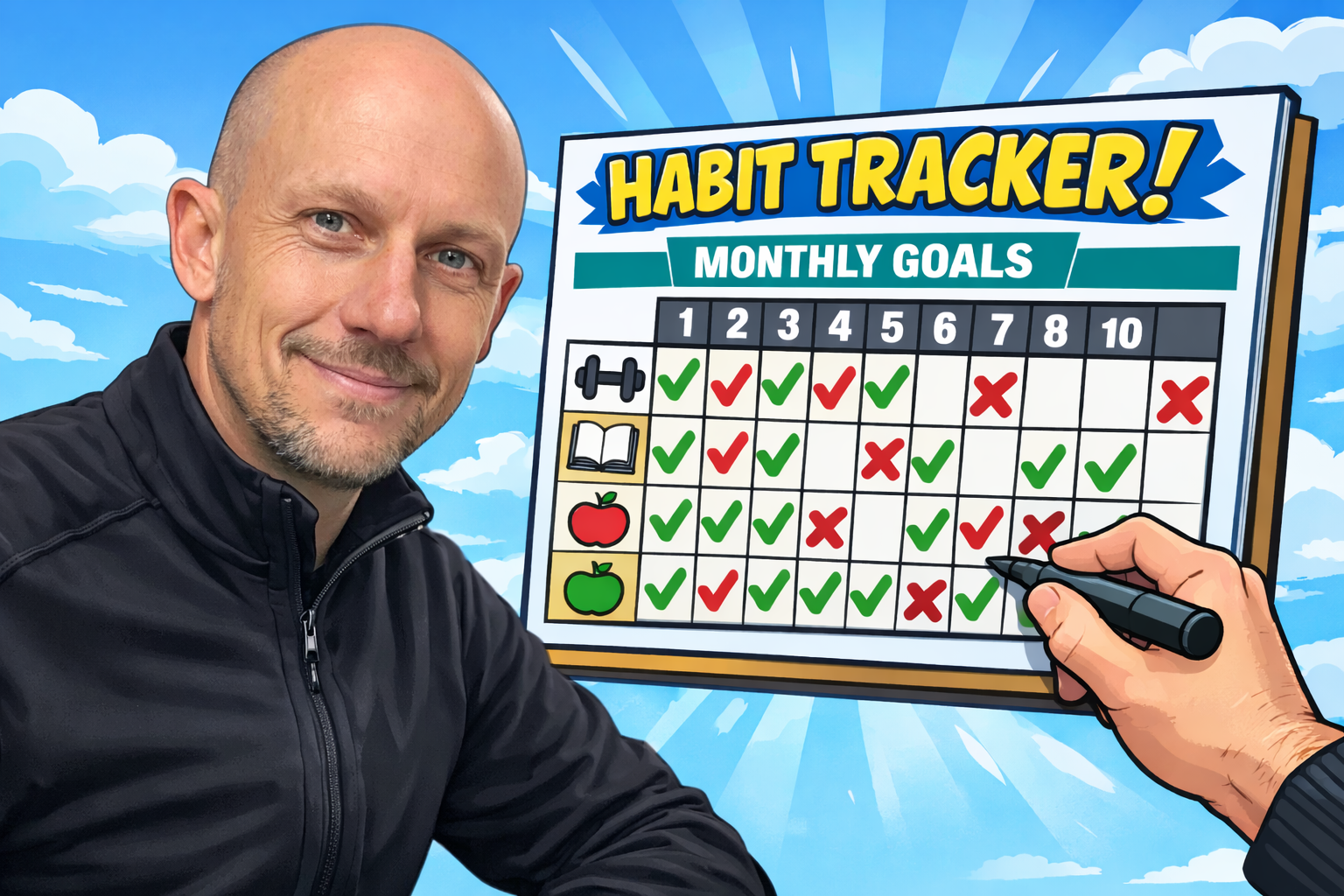
Nothing fancy. Just days of the month across the top, space for seven key habits down the side, and a box to tick if I show up. That’s it. No guilt if I miss a day, no perfection required - just visibility and accountability.
For me, that’s the magic. The tracker doesn’t force me to be better. It just removes the ability to lie to myself.
I won’t share the actual tracker just yet, but I will. And I’ll definitely report back at the end of the month with how I went - the wins, the misses, and what I learned.
If there’s one thing I’ve realised on this journey, it’s that self-improvement doesn’t have to be extreme or flashy. Sometimes it’s just a bloke making his bed, going for a run, ticking a box, and slowly building a life that feels a bit more intentional.
If any of this resonates, I’d genuinely encourage you to try something similar. Start small. Make it visible. And see where it takes you.
Michael